All these years late, it's nothing more than 'ho-hum' or even 'blah', but at one time Supertramp were kind of a polarising, love-'em-or-hate-'em kind of thing. They were revolutionary, or they were fatuous and overblown, depending on who you ask.
To me, all these years later: they're often twee, frequently disposable but sometimes have a lovely way with a falsetto vocal and a pretty little melody, floating kilometres above the song itself, in an atmospheric but somehow amorphous way. And, oh yeah, they did this.
Breakfast in America, the album, was super-huge in 1979, when prog bands were supposed to be on the run from punk bands but continued, in reality, to fill the stadiums and make the money punks could only dream of. It had four singles, one of which, “The Logical Song”, is frequently derided as terrible, but I happen to like.
It turns out that, according to Wikipedia, tensions between the two main people in the band started to heat up during this album. Rick Davies, it seems, didn't like the title song and didn't want it on the album. Roger Hodgson, his co-writer, seemed to like it enough to keep it on the album and name the album after it.
Yay Rick Davies, boo Roger Hodgson. One of those cases where skilled musicians completely forget about taste in an urge to make something 'whimsical' (hello, Paul McCartney), this song has a rum-pum-pum feel to it like some kind of, I don't know, polka or something. It makes 'ba da da da' into a vocal melody, and it presents us with lyrics about the singer's girlfriend, and about kippers.
If all this gibberish was a 'novelty song', I'd probably have to leave it alone. But the fact is that this lapse in judgement is still quite popular on classic rock stations, which sometimes exhibit a seeming lack of taste that stuns me.
The record industry was every bit as clueless back then as they are today. When the Beatles broke into the consciousness of America in 1964, the fact of their being English was seen as a big thing. On the one hand, it is true that certain darlings of the British music industry (Robbie Williams, George Michael) sell nil in the States, but on the other hand finding Brits on the Billboard chart is so unexceptional today that a good amount of Americans would probably be quite unable to identify, say, Coldplay or Leona Lewis as in any way 'foreign'. Plus, it's not like the UK is especially exotic. Let's see someone from Burundi or East Timor atop the Billboard charts: that's impressive.
Anyway, back to the 60s. The novelty of the Beatles' success was such that American record companies started scrambling for any Brisith product, and the so-called 'British Invasion' was born. To the extent that this marketing manoeuvre gave us the Rolling Stones, the Who, Dusty Springfield and the Kinks, it was a welcome development. But anyone with a discernably English accent was lumped in as the 'next Beatles' and marketed en masse to the Americans. Which led to stuff like this.
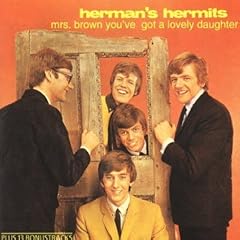
As a continuation of British music-hall and skiffle trends, Herman's Hermits might not have been that bad. It's perhaps not their fault that they were promoted to the rock market. But agony strikes listeners of oldies stations across the globe today when stuff like this is stuck in with the greats of the mid-sixties.
I mean, just listen to it. It's got a bleeding ukelele, for God's sake. Okay, Wikipedia tells me it's a muted guitar, and that's what the guy in this mimed YouTube clip seems to be doing. But it sounds like a ukelele, and behind those intolerably flat and affected vocals, it might as well be a four-year-old with elastic bands stretched over a tissue box.
Herman's Hermits, who made a few non-excruciating songs, recorded two affronts to public decency: this, and “I'm Henry VIII, I am”. The latter is a much stupider song than this one, but it's knowlingly stupid, a clever-clever pastiche that fits comfortably into the 'novelty' category. This ridiculous piece of nonsense ultimately got the nod for inclusion here because it takes itself seriously: it's a 'sad' song about a girl who has fallen out of love with the protagonist, who like a mealworm writhes up to her mother to complain about it. This video performance shows just how unmusical and lifeless Peter Noone truly was: a man with no evident musical talent who lucked aboard the Beatles' ship and rode it for a few years.
Of course, fate being what it is, “Henry VIII” and “Mrs. Brown” were both Billboard number-ones on the USA. This particular fiasco spent three weeks at the peak before being surpassed by the Beatles' magnificent, forward-looking “Ticket to Ride”. A changing of the guard if ever one existed.
The Beatles were a strange phenomenon: as a quartet, they spent a scant few years together but churned out enough great music to fill a conservatory. As four individuals? Well, the truth be told, the solo Fabs catalogues are by and large underwhelming. Most disappointing is the catalogue of John Lennon, which consists of a few amazing tracks, almost nothing truly horrible, and lots that are mediocre. The same could be said for George Harrison too, but it's less disappointing in his case, because expectations were lower. It might be true that George Harrison was the first one to break the Beatles mould, and the first one to have a solo hit (the truly impressive 'My Sweet Lord'), but he was also the first one to descend into a quagmire of humourless, samey-sounding tracks (this is a particular riddle of the solo Beatles: why four people who, as individuals, had diverged to such an extraordinary degree would each find their principal early- to mid-70s sonic template in the same source: 'While My Guitar Gently Weeps'. The Apple solo years are simply swimming in that basic glossy guitar sound, the same one the Threetles returned to for 'Free as a Bird' all those years later.)
By the late seventies, it was difficult to imagine yourself caring at all about George Harrison, except as a producer of movies featuring midgets and/or Pythons. By what I'll cruelly describe as a stroke of luck, the murder of his ex-bandmate gave him a jolt of relevance with the admittedly wonderful 'All Those Years Ago', but it was then back to business as usual. Until 1988, and his last major album released during his lifetime. This song illustrates two great truths - one: that there is no relationship whatsoever between a song's quality and its popularity, and two: that the year 1988 exhibited a particularly inverse relationship between quality and popularity. What else can explain this particulary horrid song making it all the way to number one on Billboard? A washed-up has-been singing a resurrected, and previously ignored, 'oldie' that appears to consist of nothing more than its title and the phrase 'to do it' repeated over and over... and over.. and over again. Plus that damned torture instrument of the nineteen eighties, the saxophone solo. Truly annoying, this song should have been an embarrassment that the record company rejected and refused to release (something that repeatedly happened to Harrison in the 1980s). Instead? Hello #1 and 'comeback'.
How? Why? Was no one in radio in the late eighties actually listening to songs before putting them on their playlists? How could a song this god-awful chart so high?
Oh, and two other questions inspired by watching the video: how could the man who, during 'Let it Be', pretty much defined 'good hair' rock such a plastic mop? And two, how could Alexis Denisof, Wesley from Buffy the Vampire Slayer and Angel, actually outgeek his Whedon roles in his youth?
Of those 1960s 'greats' who Baby Boomers just won't let you stop hearing, the Who are, to me, the most mystifying – with the most threadbare of a back catalogue, decent mid-sixties R&B too quickly mutating into 'rock operas' and all kinds of other humourless stuff. That's not to say there's anything (necessarily) wrong with rock operas and their ilk, but in the particular case of the Who, they just do nothing for me. The bigger their egos got, the worse the music. Maybe that's unfair – with a few exceptions, the Who's music is never bad; it's just not good either. It's merely there, like that uncle who you feel compelled to invite to all the family get togethers even though you never have anything to say to him and he mostly sits in the corner in awkward silence... at least they've given the CSI franchise enough fist-in-the-air theme songs to fill a station's syndicated daytime programming schedule.
The only thing worse, it turns out, than the Who in their humourless quasi-'majesty' is the Who trying to be funny – or worse, charming. Songwriter Pete Townshend himself says he doesn't really know why his band performed this knock-off song of his, but as for the compostion, I just imagine he was tired of all the sophomoric jokes being written by bassist John Entwistle. So here he pulls out the accordion, goes all oompah-oompah, and writes a song about his parents having sex. Or rather, his father playing with his mother's breasts. For the secret, you see, of Townshend's clever-clever lyrics are that he's not really talking about an accordion... I'm sorry if I've spoilt the innocence of any six-year-olds out there, but it's by about age seven that a child would get this song and find its humour guffaw-worthy.
It comes down again to the careful art of the novelty song. Comedy has a place in music, but it has to be carefully done in order not to become annoying after the first listen. Given that 'classic rock' stations, who regularly demonstrate a complete lack of understanding as to what makes a song 'classic', play this song with such a regularity, it had better be carefully done. Alas, it is clearly a knocked off little knees-up ditty, a follow-up to Chuck Berry's “My Ding-a-Ling”. And just as annoying.
Roger Daltrey, of course, shreiks his way through it the very same way he shreiks through ever Who song, regardless of content, meaning or form. Oh well. Shreiking is good for the soul – I know this, because listening to this song makes me want to do that very thing.
Ah, Depeche Mode... perpetually soundtracking teenagers' mood swings into melancholy down the years. I shouldn't knock that, actually: it's a very valuable public service, one that Robert Smith of the Cure could be helping them at if he weren't prone to releasing 'pop' singles every now and then.
It's very easy to make fun of Depeche Mode - and probably very reasonable to do so as well. There's much to laugh at, from Martin Gore's arrested-development angst to Dave Gahan's nuance-free bellow of a voice. Yet they have, perhaps against their will, come up with a decent handful of greatness. In fact, the trilogy of albums Black Celebration, Music for the Masses and Violator (which so happen to coincide with my personal melancholic teenage years) are impressive enough to actually make a case for Depeche Mode as - gasp - one of the greats.
Well, in a manner of speaking. Depeche Mode is currently songwriter, singer and accountant. There used to be a fourth, Alan Wilder, who joined the band late and left it early, quite unsung and best known now for the part of his website where he talks about his days in Depeche Mode. But if you ever wonder who made those three albums so great, look no further than the song "Never Let Me Down Again". On paper, it's terrible: completely melody-free, Gore leaves Gahan to bleat the barrel-of-cliché lyrics as a mere tick-tock between two notes. Gahan decides to compensate by oversinging, even by his standards, and bellows the whole thing out in a thick baritone that would make Jim Morrison blush. And yet... the song is wonderful. Wait, no: the song is bollocks. The recording is wonderful: widescreen, lush, with sounds coming in all over the spectrum. That's what Alan Wilder did in Depeche Mode, and why their glory years are so limited.
Mind you, Alan Wilder also co-wrote "Work Hard", which vied with the current song for 'worst Depeche Mode song' in my book. If you've never heard it... well, don't. Depeche Mode went through a phase of fetishising manual labour and capitalism, and threw in kilograms of cheese. Avoid.
No, I tip my hat to Messrs. Gore and Fletcher, who nominated "What's Your Name?" as 'worst Depeche Mode song ever'. In deference to them, I agree.
What is this fresh hell? Well, Depeche Mode was originally a very, very different band. Their first album, Speak and Spell, is coloured by two things: one is the songwriting of Vince Clarke, who dominated the first album and then left the group before they recorded their second. The other is a kind of glorification of rinky-dink keyboards. Depeche Mode have, of course, always been a keyboard band, but there's a Kraftwerkesque 'go machines go!' theme to the first album that occasionally succeeds (especially in moodier mid-tempo tracks) and occasionally falls spectacularly flat, especially all these years later, when the whole album sounds like a Nokia ringtone.
Vince Clarke has written some amazing songs. In fact, I've heard tell that one of the reasons he left Depeche Mode was because of disagreement over his song "Only You". It seems the others in the band didn't want to record it. if this is so, we can, as Depeche Mode would later say, 'thank the Lord for small mercies', since it breaks my heart to imagine what Dave Gahan's walrus of a voice would have done with that beautiful song that Alison Moyet gets so spectacularly right. The début album is not that bad, except for the two 'boy' songs. Oddly enough, nobody in Depeche Mode is gay, not even songwriter Vince Clarke (I just checked online), so these lyrics make even less sense. The problem with the lyrics is not their kinda-gayness, which is entirely whatever. The problem is just how ridiculous this song and "Boys Say Go!" are. This song is entirely built around the line "hey, you're such a pretty boy", and it's happy-go-lucky to the point that it's quite nauseating (the background singers chime in, "P-R-E-double-T-Y"). For a band whose subsequent career was built around moodiness, it's shocking to hear how happy-go-lucky, naïve and tacky they were when they started out.
I think punk, as a music genre and as an ideological or lifestyle 'movement', is largely an uneasy alliance of two remarkably different types: one group of people who see it as a rallying call, a form of protest, and one group who see it as an agenda-free release of energy or tension. There are 'revolutionaries', but in just as large measure there are mere empty nihilists as well. People who hate the system for the way it holds people down and seek to destroy it in order to replace it with something better, or people who hate the system merely because it's there and seek to destroy it with no thought whatsoever for what comes next.
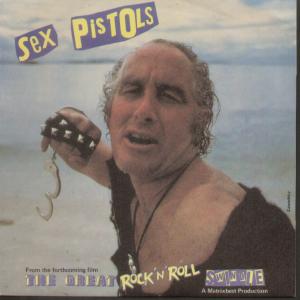
The band that is remembered as the founder, the architect and the 'leader' of (British) punk music, the Sex Pistols, contains both in equal measure. Notably, Johnny Rotten, the primary lyricist, was resposible for the words of those epochal early singles that are both undeniably exciting and filled with a sense of self-importance: this was inarguably a band with something to say (much of the band's destroy-passersby sheer nihilism, it must be added, comes from him too). Equally notably, though, is Sid Vicious, the poster boy for vacuous violence and wanton, pointless thuggery. Sid Vicious made real all of the things that 'adult society' were saying about punk. His glorification also spelt the end of punk as potentially a force for real change. The band the Sex Pistols became, certainly after Johnny Rotten's departure but even before it, represented everything base about punk. This was a band that had abandoned incisive social criticism for purposeless button-pushing, a band that had, like lexicographers before and after, confused anarchy with mere chaos. The Great Rock 'n' Roll Swindle album and its attendant singles are very difficult listening indeed – no improvement whatsoever on the fatuous music they had allegedly set out to destroy.
Among many competitors, the song that stands out as being most tellingly horrible is “No One is Innocent”, sung (if you can call it that) by Ronnie Biggs, an escaped convict living in Brazil. His 'outlaw' status, I supposed, tickled the fancy of the remaining Sex Pistols, so they cheerily went ahead and let a boorish old man bellow tunelessly over punk-by-numbers. His bleating vocals are enough to merit inclusion here, but the self-serving lyrics are so childishly and stupidly baiting and offensive to make the case all by themselves. Glorifying child-killers and Nazis (not to mention glorifying himself, an escaped convict), Biggs associates the Sex Pistols with all kinds of unsavoury connections, sullying their genuinely revolutionary early years and calling into doubt their entire legacy.
It's no accident that punk split on one hand into a more explicitly political camp (including so-called 'hardcore' bands) and on the other hand into trash that was merely boorish at the best or explicitly hateful at the worst, cheered on by the skinheads and ultimately spawning neo-fascist bands like, for example, Skrewdriver. Siouxsie Sioux and Sid Vicious may have worn swastikas as a bait to the older generation's conventions regarding morality, but the repeated baiting, with no observable sense of irony, did nothing to obscure a genuine contempt for the sufferings of others. Putting a swastika on the cover of one of your singles, calling a song “Belsen Was a Gas”, recording Biggs saying Nazis weren't wicked, “that was their idea of fun”... with time such 'taunts' start to sound like convictions, and the Sex Pistols' flirtation with Nazi symbolism starts to look like sympathising. And that's the sour taste their legacy leaves in my mouth. That's the reason that they, in the end, changed nothing, and all their revolutionary zeal was just so much hot air.
Ah, the White Album... that testament to the awe-inspiring power of the human ego. You know, George Martin apparently begged them to make it into a single album. Well, duh... With judicious editing, you can break the White Album into two different albums: one would be perhaps the greatest album they've ever made, and one would be perhaps the single worst slab of vinyl ever.
It'd be an interesting exercise to see how most people would accomplish that feat. While it's certain that everyone would deservedly put "Bungalow Bill" on the garbage disc, and most people of taste would put "Ob-la-di, ob-la-da" there too, I imagine a lot of people would put "Revolution 9" there, which personally I enjoy quite a bit. And most people would give "While My Guitar Gently Weeps" pole position on the good-disc, whereas I can't stand that song's overblown grandiosity.
There's a lot I could have chosen from this album. The atrocious "Birthday" and "Piggies" come to mind. Yet I've included the truly horrendous "Helter Skelter" because while it's every bit as cynical and smug as half the other songs I've mentioned (plus "Honey Pie" and "Savoy Truffle"), it is actually convinced of its own worth, being as pathetic an attempt at 'rocking out' as anything I've heard. Talented musicians pretending they can't play, misquidedly confusing weedy screeching with 'passion', the Betales here don't sound like they're just throwing crap out there to fill up a disc; they sound like people who are trying and just falling spectacularly far from the mark. As ridiculous as this song, with its fake fade-out and "I've got blisters on me fingers" bluster, there apparently exists a 15-minute outtake of it. Can you imagine if this song, interminably long at four minutes, actually did go on that long? Blisters on my ears. And blisters on my respect for the Beatles' craftmanship.
We’ve got a bit of a double-feature this week, looking at the same artist at his very best and at his very worst.
Phil Collins has nothing to say. I’m sure he’ll tell you that himself. I don’t believe at all that artists must be tortured to make great art, but it’s very difficult to make your art have meaning if you’re a happy-go-lucky guy. Ask Paul McCartney. Or Mike Love. At least they had ‘darker’ partners who could balance their essentially meaningless cheeriness. After Peter Gabriel, who was going to provide that valuable service for Phil? The guy from Mike and the Mechanics?
Phil is not talentless. On this very album, the dark and moody “Mama” is a minor masterpiece of storytelling. The problem is that he gives too little consideration to taste.
Case in point, this: one of the most insulting and offensive songs ever written. Genesis claims that it’s meant to be an ironic parody, but I can’t see that at all.
What I see is a bunch of wealthy white English men taking the real and tragic plight of immigrants and turning it into a clown-show worse than Pat Boone’s “Speedy Gonzales”.
Phil Collins sings the whole song in a stereotypical ‘Mexican’ accent. The lyrics make your toes curl, filled with all nature of innuendo about immigrants in general and Mexicans in particular. The song’s middle-eight suddenly transforms into a mock-‘ethnic’ jangle, like “Ob-La-Di, Ob-La-Da” only, if this were possible, worse.
The video features Phil and the other two looking as ‘greasy’ as possible engaged in the escapades depicted in the lyrics, a performance that makes Peter Sellers’s Indian characters the very model of respectful depiction.
And, on top of all of this racist, xenophobic garbage, the song itself is crap too: built on a cheesy keyboard riff and with the least natural verse-to-chorus transitions. The chorus reduces a complex international political issue to the sentence “it’s no fun being an illegal alien” chanted over and over again.
“Fun” and “alien” don’t rhyme, you say? Ah, but you miss the power of Phil’s crap Speedy Gonzales accent. The song features a ‘breakdown’ near the end with dozens of people singing and clapping this line while Phil does ridiculous soul-boy-cum-minstrel show ‘vocalisations’. Then that damned synth line comes in. And an entire nation hangs its head in shame.
Not only is it a shame that Genesis saw fit to record this and release it, but their record company even decided to release it as a single. Why? Did they not care who they might be insulted by this? Was their desire to make a racist joke so strong that they felt they needed to do it at all costs?
Just in case you think there's nothing I like out there – I don't dislike 10cc. I don't know much about them, but I can tell you “I'm Not in Love” is one of the most beautiful, most atmospheric songs from the 1970s that I know. It's not that 10cc is crap – just that this, one of their most well-known songs, is.
It appears that this is the tale of an English man on holiday in Jamaica, who is assaulted by some Jamaicans and decides to respond by claiming to love things Jamaicans stereotypically like: namely, in turn, cricket and reggae. In the end, he is seduced by a Jamaican woman, and decides (as far as I can tell – the lyrics are banal beyond belief) that he loves Jamaica (or alternately, loves the seducer but hates Jamaica). Whatever. What is is is embarrassing cod-reggae by people with no specific appreciation for the genre or the culture it's rooted in. It's crass and, what's more, it's annoying. How many times have you been in a mall or an office somewhere and heard “I don't like reggae; I love it” quietly in the background and, like a code word that triggers a trained Doberman, suddenly and inexplicably filled you with rage and an urge to kill? That's what this song (and its horrible accompanying video) can do. This was a number one in England. Shame, England, shame.
I may well get crucified for this one: I know this is a well-loved song. The thing is that I can’t stand it. As a general rule, I hate all baseball music, and I’m not even sure if this is a baseball song. I don’t think it is, in fact: Mark Knopfler is British, and the song’s lyrics seem to say something about songs or music or something. Perhaps the ‘walk of life’ is a dance. Don’t know. Don’t care.
It’s the organ, you see. That’s what makes it ‘baseball music’. The rinky-dinky rink organ that just calls out ‘me and the boys having a good time with beer and barbecue’. Kind of like “Glory Days” by Bruce Springsteen, equally cringe-worthy. The whole thing reeks of a kind of fake enthusiasm and ‘gusto’ that is about as catchy as a lead pipe. I recently spoke about “Lay Down Sally” by Eric Clapton, and this song has pretty much the same qualities. I love happiness and breeziness and meaningless good-time party vibes in music. But if there’s some sincerity to it. This sounds like what a robot programmed to come up with ‘fun music’ might produce.
And as far as headbands go, none was more evil than Mark Knopfler’s. The ‘CD test’ album this came from, “Brothers in Arms” had a gorgeous title-track but also “Money for Nothing”, whose repugnant lyrics (ah, but it’s tongue-in-cheek, not really homophobic and demeaning at all) might make it even a worse song than this one if it weren’t for the fourteen-second solo guitar part that comes in about half a minute into the song and is the best fourteen-second solo guitar part on any guitar-wank technophilic CD to be released in the mid-eighties. So that’s why “Money for Nothing” isn’t here and this is.
Oh, plus the fact that I want to squeeze my head in a vice to stop the pain every time I hear this song.
Oh, plus the headband. This song deserves inclusion for the headband alone, if nothing else.
Apparently, when I was, like, four, I amazed my father and several of his friends by being correctly able to identify the song “Layla” by its opening guitar riff. I have no comment on how I was able to do that (especially since it would have been a years-old mouldy oldie at that time), but I can confirm that I like that song quite a bit.
Which makes it perhaps the only Eric Clapton song I’ve liked in his 40-some-odd years as a professional musician.
Yes, yes. Eric Clapton is God. I know, I know. Thing is, I don’t believe in God, either.
For me, the moment of truth was finding Time Pieces: The Best of Eric Clapton in a cutout bin. I knew I liked “Layla” (and that rubbishy acoustic version had yet to come out) and seemed to recall having heard a song or two of his that I didn’t mind. Plus, the universe was filled with people all too willing to tell me how great Eric Clapton is. So I saw it there looking me in the face for, like, $3 or something, and gave it a go.
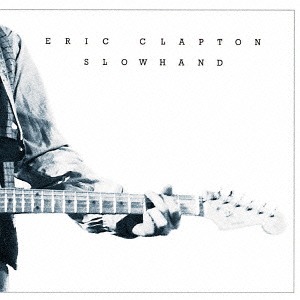
Time Pieces: The Best of Eric Clapton is perhaps the worst greatest hits album ever, beating out even Shaquille O’Neal’s. I know, it sounds like iconoclasm for its own sake, but it’s a simple fact. A more inept album I could not imagine. Except for the great “Layla” and the acceptable “After Midnight”, it’s laziness from start to finish. For a man allegedly so connected to the blues, Clapton seems to have no soul, no passion or feeling whatsoever. He is a piece of cardboard. He can play guitar well enough, but so can Yngwie Malmsteen, and that doesn’t mean anyone ever wants to listen to him either.
I’ve chosen the excruciating “Lay Down Sally.” But equally legitimately it could have been “Cocaine” or “Willie and the Hand Jive” or his embarrassing take on “I Shot the Sherriff”. It could also have been “Tales of Brave Ulysses” or any of the every-now-and-then interchangeable singles he’s released over the past fifteen years that have a vague soft-rock feel but are produced by R&B svengalis like Babyface. All deserve to be here, frankly.
“Lay Down Sally” is the most depressing because it attempts to be ‘jolly’. Because we know you have to have a heart to have one broken, we can immediately recognize soulless robo-emoting on supposed ‘sad songs’ as the pretense it is. Because this preposterous little ‘down-home shuffle’ sets its sights so low, though, we may not immediately realize how it is affected by Mr. Clapton’s critical lack of a soul.
But affected it is. The wholly unconvincing ‘good-timey’ vibe (with female b-vox appearing in time for the chorus) actually accentuates its total lack of personality. ‘Good-timey’ only works if it’s charming, and I can’t imagine anything as charmless as this.
It’s wrong to speak ill of the dead, I know. And in this particular case, his premature, unnatural death is genuinely tragic. Very sad.
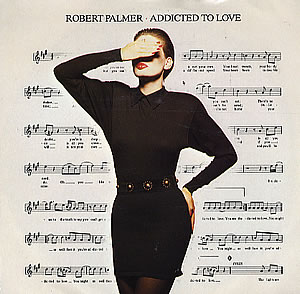
Yet this does nothing to change the fact that the decades-long career of Robert Palmer was, pretty much without exception, horrible. After spending the seventies as a dilettante, making facile covers in a variety of genres spiritually alien to him (and the casual cheesiness and sexism of merely the album covers from this decade pretty much tell you everything there is to know), Palmer settled into the 80s as one of the best faces for the naked greed and ambition people ‘his age’ had developed by then.
It’s difficult not to have a love/hate relationship with the 80s. On the one hand, there was so much great music made – primarily music made for the consumption of kids, music that was scorned by the post-hippie ‘style makers’ of the time. Then there was this: ‘beer commercial’ music made by people wearing suits (not that there’s anything wrong with suits, mind you) and intended for mass consumption by people for whom music is a background – something for the ghetto blaster to play while playing catch in the backyard, for example. Not only is it music without a soul, it’s music that fetishises its lack of a soul.
Theoretically, I could have chosen any Robert Palmer song for inclusion here, and certainly it was a toss-up between this, its clone “Simply Irresistable”, “Some Like it Hot” (all the more reprehensible because Duran Duran and Chic, the ‘main bands’ of this side-project’s other members, were otherwise making decent music) and Palmer’s 1970s intro to corporate-rock, “Bad Case of Loving You”. All are equally terrible, all are interchangeable. Ultimately, it has to be this one, though. For several reasons:
That video. As so often happened in the 80s, confusing ‘sexist’ with ‘sexy’, it’s a leering, drooling, sneering video, present ‘women as musicians’ as a comical concept. All surface, no depth, ‘cool’ in intention but ultimately icky, it fit its soundtrack perfectly.
Clichés in lieu of meaning in the lyrics. Lyrics don’t have to have meaning, but they shouldn’t be just a long litany of cheesy wannabe-aphorisms like “The lights are on, but no-one’s home” either.
The line “your teeth guh-rind”. This teeth-cuh-lenchingly annoying line is ultimately the reason I chose this airbrushed muscle-man ode to naked ambition over any of its creator’s other, um, masterpieces. I can wake up in the night in a cold terror thinking about that annoying two-syllable ‘grind’. Truly, truly dastardly.
That this, shockingly enough, was designed as a duet with the truly magnificent Chaka Khan goes to show both how misguided the mid-eighties’ sense of ‘soul’ was and how lucky this English-Bahamanian was to have been born in the era where his sleazy soul-boy dribblings could, for reasons I’ll never understand, be interpreted as in some way ‘authentic’.
Alternately, I suppose Chaka just needed the money.
More than one significant voice in online punditdom has declared Starship’s “We Built This City” the single worst song in the history of recorded sound. I have to admit that that song’s vacuity is tough to beat.
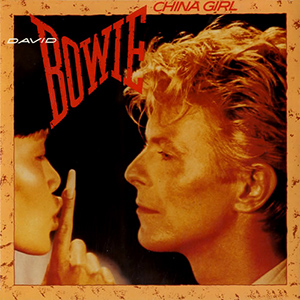
For me, though, I’m nominating “China Girl” as the worst song in the history of the universe. My particular hatred of this song has largely to do with the fact that it was created by the same human who had, just in the previous few years, created music as divinely transcendent as “‘Heroes’” and “Under Pressure”. Undoubtedly following Bowie through the years will always be a difficult task, not because of his stylistic jumps but because of his not-too-occasional lapses into toe-curling banality. It’s an ongoing thing. I mean, how to reconcile that the very album that contains the great “Rebel Rebel” and “1984” could actually be titled after the completely horrible “Diamond Dogs”?
Oh, and there was Tin Machine. In fact, there was the entire 1980s…
Bowie pissed all over the 1970s. His 1970s discography is such an embarrassment of riches that, by the time Scary Monsters came out, the fact that the album wasn’t up to much didn’t stop it from being a triumphant coronation. So much so that Bowie was able to hop from Elvis’s record company to EMI, the label the Sex Pistols had so recently decried. Eager to suck that corporate teat, Bowie suddenly put on a suit and bleached his soul of anything approaching ‘edge’, ‘passion’, ‘integrity’ or ‘enjoyable music’. He came out with an album called Let’s Dance. As Reagan and Thatcher celebrated recent victories, this new plastic-Bowie sold by the boatloads.
The album is, from start to finish, garbage. It’s all bathed in echo, with Bowie’s basso ridiculoso crooning/groaning over top, cheesy background vocals, cheesy guitar, and… shudder… 80s saxophone.
Is there anything more terrible than the sound of a saxophone honking on a song made in the 1980s? I have no real qualm with that particular instrument, and I love 80s music, but the two just do not go together. From 1980 to 1989, the saxophone almost consistently lowered the quality of songs it was on.
Oh, sorry, was I talking about “China Girl”? “Let’s Dance” and “Modern Love”, the other two singles from this album, may well feature in the top ten of worst songs ever recorded. However, they don’t quite make my skin crawl as much as this song. Apparently, it’s a ‘cover’ of a song he co-wrote with Iggy Pop before his creative bankruptcy. I must admit having never heard the song. Iggy Pop acolytes claim it’s ‘subversive’. Maybe. Maybe the garbage lyrics are in some way a ‘statement’ on east-west relations when handled by Mr. Pop. However, in Bowie’s mouth, they are nauseatingly ridiculous, as he sings, completely without irony, that he feels ‘tragic like Marlon Brando’, that he ‘stumbles into town just like a sacred cow’ and that when he gets excited, his ‘little China girl says “obey me, just you shut your mouth”’. All with a little ‘Oriental’ guitar riff on top.
And it comes in service of a video featuring him pulling the sides of his eyes ‘Chinese-style” and, later, rolling around bare-assed on the beach with said ‘Chinese girl’. Whether all of this is meant to be sexy or merely repulsive is never made clear.
For Bowie, it scarcely got any better than this for a good ten years. If a sadder tragedy has ever been seen in the annals of modern music, I know it not.